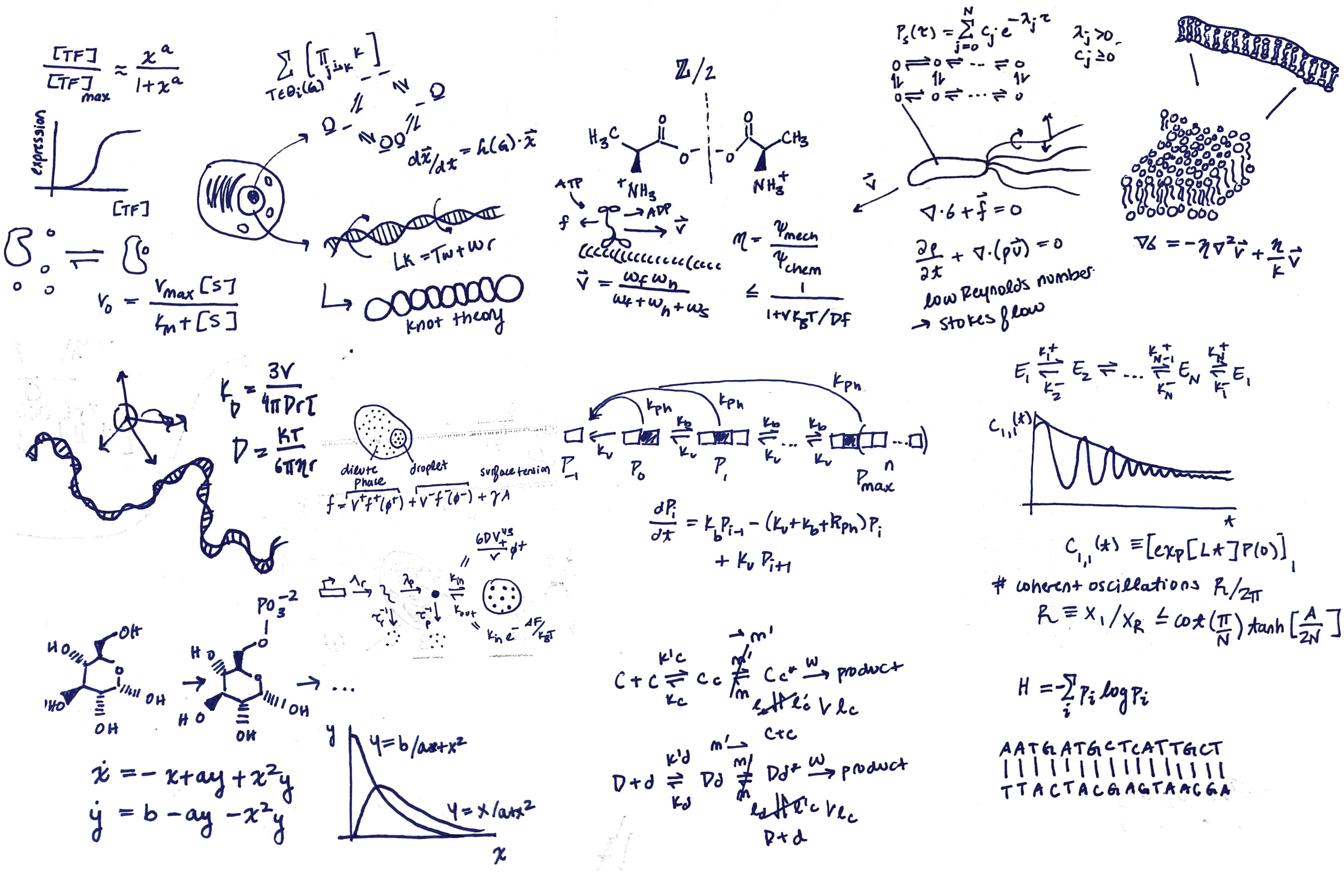
A unifying theme of my research is understanding how the structure of a network governs its dynamics. Much of my work develops graph-theoretic tools to study this relationship in biochemical systems. A recurring construction across my research is a singular limit in which a single parameter is sent to infinity, inducing a dimensional collapse of the underlying graph. This construction has proven fruitful in two distinct but deeply connected settings: the dynamics of continuous-time finite-space Markov processes represented by linear framework graphs, and structural identifiability of linear compartment models.
Asymptotic graphs
The linear framework is a graph-theoretic approach to continuous-time Markov processes in which vertices represent states, edges represent transitions, and edge labels represent transition rates. This structure allows steady-state probabilities and transient quantities to be expressed as rational algebraic functions of the edge labels. Building on recent operator-algebraic extensions of the linear framework, I introduce a new graph operator, the asymptotic graph, that captures the limiting behavior of a linear framework graph when a single edge label is taken to infinity. The construction resembles an edge contraction: one vertex collapses into another, reducing the dimension of the system by one. We show in this work that key graph invariants of the asymptotic graph are the true limits of those of the original graph, including steady-state distributions, moments of the first passage time distribution, and the characteristic polynomial of the graph Laplacian. Notably, the asymptotic graph commutes with other graph operators in the linear framework, a result that points toward a richer algebraic structure underlying the construction.
Structural identifiability under singular limits
In collaboration with Marisa Eisenberg, we investigate how structural identifiability is affected when a single parameter of a linear compartment model is sent to infinity. Structural identifiability addresses whether the parameters of a mathematical model can be uniquely recovered from ideal, noise-free input-output data, a foundational question for any model intended to be calibrated against experimental measurements. We show that such singular limits induce a collapse of the underlying linear compartment graph resembling an edge contraction, producing a reduced model whose transfer function is the limit of that of the original. From this, we characterize which parameter combinations survive the limit and how identifiability is lost or preserved. We illustrate these results on several families of linear compartment models, including mammillary, catenary, and cyclic networks, and discuss connections to model reduction and the geometry of parameter space. The structural parallel between this construction and the asymptotic graph construction in the linear framework setting points toward a unified mathematical theory of singular limits in biochemical reaction networks.
Signatures of non-equilibrium steady states
Detecting non-equilibrium behavior in biological information processing systems poses a technical challenge in both experimental and theoretical contexts. Several mathematical signatures of broken detailed balance in Markovian systems have been proposed to address this difficulty. Part of my doctoral work focused on characterizing the mathematical behavior of one such signature: the Steinberg signature, which detects non-equilibrium behavior through the inequality of forward and reverse higher-order autocorrelation functions. Using the linear framework, we show that when a system is driven progressively away from equilibrium, the Steinberg signature reaches a maximum at an intermediate value of thermodynamic force before decaying asymptotically to zero. We prove analytically that this decay occurs in the limit of infinite energy expenditure, demonstrating a fundamental limitation of the signature as a detection tool. On larger graphs, the signature displays a more complex landscape of behaviors. These results clarify the relationship between mathematical signatures of non-equilibrium and the underlying thermodynamic forces driving them.
Disguised toric systems and the geometry of reaction networks
By viewing reaction networks as Euclidean embedded graphs with rate constants, this machinery is frequently used to interrogate the relationship between a network’s structure and its associated dynamics. There exist certain conditions on the rate constants, called the toric locus, which allow a network to employ a particularly stable dynamics. Sometimes a system appears to have a toric locus, but lacks the typical structural features. Such systems are called disguised toric systems. In collaborative work with Polly Yu, Matthew Satriano, and Miruna-Stefana Sorea, we show that the parameters that give rise to disguised toric loci are preserved under invertible affine transformations of the network. Affine transformations are studied here because they preserve structurally important features of reaction networks, such as a network being strongly endotactic. That is, we demonstrate that certain alterations to the network structure preserve special dynamics. We further show that disguised toric conditions are not preserved under other types of transformations, such as projective transformations. This work provides a concrete example of how network geometry and topology influence qualitative dynamics, and is published in SIAM Journal of Applied Dynamical Systems.